Outrage Isn’t Enough
We Need To Get Serious About Immigration Reform

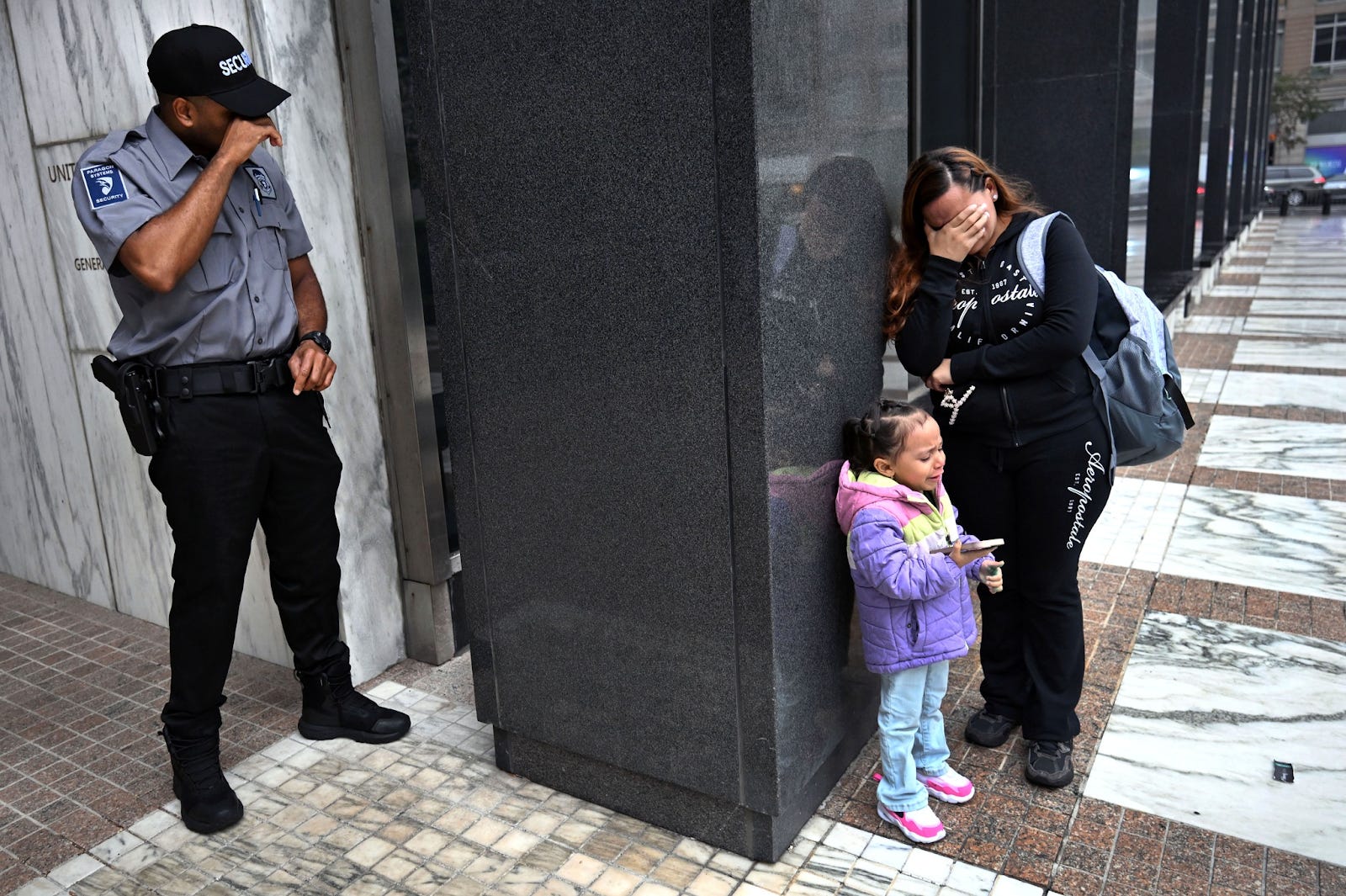
Over the past year, President Trump has systematically pursued his goal of deporting as many immigrants as possible, regardless of whether they’ve committed crimes or pose any threat to public safety. Even a decades-old civil immigration violation can make someone a target for removal, no matter how long they’ve lived here, how much their family depends on them, or what contributions they’ve made. As more stories of longtime residents being abruptly detained or deported come to light, the outrage from media and Democratic leaders grows.
While many of Trump’s enforcement actions are reprehensible, they are mostly legal. His administration is enforcing removal orders issued by immigration judges and finding new ways to revoke legal status, widening the pool of people who can be deported. Any immigrant, regardless of status, who has applied for financial aid, served in the military, or even paid their taxes, now risks having their information mined for immigration enforcement.
Trump is weaponizing immigration law to harm people, but the system that allows him to do so was built by Congress. Decades of Congressional inaction and failure to pass meaningful immigration reform have left millions vulnerable to a president willing to use the full force of the law against them. So what are we going to do about it?
We’ve been here before. During Trump’s first term, the country erupted in outrage and even mobilized against policies like the Muslim Ban, family separation, and countless other inhumane acts. When Democrats won back the White House and Congress, they failed to channel that outrage into immigration reform. At the border, they were overwhelmed by a migration crisis. For undocumented immigrants already here, Democrats simply returned to the policy of deprioritizing deportations for Dreamers and longtime undocumented residents. Republicans, for their part, offered endless bills further restricting immigration. To cap that all off, they renominated Trump.
Trump is making good on his promise of delivering mass deportations. He has pushed the bounds of immigration law to do so, often utilizing obscure provisions in ways no other president has, like arresting college students for protected First Amendment activities if they criticize the president’s foreign policy.
As another election approaches, we should reflect on the kind of leadership this moment demands. Even if our options beyond litigation are limited, November 2026 is an opening. Every voter has the power to support candidates with a genuine vision for immigration reform. That is the work ahead of us.
Less Than a Million Deportations, but Just as Devastating
The latest deportation data reveals the reach of Trump’s mass deportation campaign. According to the Department of Homeland Security (DHS), his administration has deported 527,000 immigrants from the United States. As in past administrations, some have prior criminal convictions—but that category covers everything from unpaid traffic tickets to violent crimes.
The administration has not released official numbers showing the breakdown between those with and without criminal convictions. But recent data collected by the Deportation Data Project show that the majority of people arrested in cities like Los Angeles and Chicago only had a civil immigration violation. We also know that most of the people being removed did not recently cross the border. Apprehensions of migrants at the border are at historic lows this year, so the majority of Trump’s deportations are coming from within the interior of the country. That means most of those targeted have deeper ties in American communities.
For context, the previous record for annual deportations was set by President Obama in 2012, when about 400,000 people were removed—more than half were recent arrivals at the border. It is much easier to deport a person who has been in the country and held in a Border Patrol station for three days than a person who has established a life in the United States for years. Similarly, during Trump’s first term, deportations peaked in 2018, when roughly 337,000 were removed, again largely recent border crossers.
Given the staggering human cost of his actions so far, Trump’s failure to meet his goal of deporting one million people in a single year offers little comfort. When ICE and CBP conducted operations in Charlotte, North Carolina, last month, 30,000 children stayed home from school the next week. The harm extends beyond those deported, affecting entire communities who watch as their neighbors and friends are taken away. Behind every deportation is a spouse left behind, an employer losing a trusted worker, or a child suddenly facing a future without their parents.
Trump’s constant vilification of immigrants over the last decade has desensitized many people in this country to mass deportations. He has blamed immigrants for the pain many Americans are feeling over the cost of living crisis, high healthcare costs, and an increase in crime. But as the consequences of his enforcement policies ripple through the economy—shrinking the workforce and driving up the cost of daily goods— my hope is that more and more people realize that we can and should enact policies that integrate immigrants into our communities without leaving Americans behind in the process.
Our laws give undocumented immigrants few options. There is no legal status they can apply for, no fine they can pay, no process to make things right. This is a failure of the system itself. While we should hold people accountable for violating immigration laws, mass deportations tear apart communities and hurt the economy. That’s likely why no president before Trump has tried to do it.
Until Congress changes the law, the only alternative to mass deportation is for the administration to restore prosecutorial discretion and allow people to remain in the country without legal status. This is what presidents of both parties have typically done, target immigrants who pose a threat to public safety, national security, and border security for deportation, while leaving the rest of the undocumented population in legal limbo.
We Need Congress to Fix This
To understand why relying on prosecutorial discretion alone is problematic, consider the case of Any Lucía López Belloza, a 19-year-old college freshman studying business at Babson College in Massachusetts. She was flying from Boston to visit her parents in Texas for Thanksgiving when she was detained at Logan Airport and deported to Honduras—a country she has not lived in since she was a small child.
Any, and other Dreamers like her, have almost no legal options to stop their deportations. Any already had a final order of removal, giving the government full authority to deport her. Even if the administration were ordered by a court to bring her back, DHS could detain and deport her again. Under this administration, there is almost no legal option for her to return to her family in the United States or go back to school.
Any’s story reveals why Congress’s multi-decade failure to protect Dreamers is so devastating. Any was eight years old when her family fled violence and instability in Honduras in 2014. They were arrested at the border and later filed an asylum claim, which was denied. Like many undocumented families, they stayed, living quietly for years and were never prioritized for removal under Trump’s first term or the Biden administration.
In 2012, President Obama created the Deferred Action for Childhood Arrivals (DACA) program to provide temporary protection from deportation and grant work permits to immigrants brought to the United States as children. Any is one of three million Dreamers who never qualified for DACA and remain unprotected today.
DACA was never meant to be the only solution to protect Dreamers. It was a stopgap measure to buy time until Congress could pass the Dream Act, a bill that would offer a path to citizenship for Dreamers who meet certain requirements. The bill was first introduced in 2001, and has been reintroduced in different versions 20 times since. On December 4, Republican Senator Lisa Murkowski and Democratic Senator Alex Padilla reintroduced it once again. But unless Trump suddenly decides it serves his interests to support it, it has no chance of becoming law.
Every election cycle, politicians from both parties promise a permanent solution for Dreamers, even President Trump. But every time, those promises end with the campaign.
Imagine a life where your future depends entirely on the outcome of every election. That has been the reality for millions of our neighbors for decades. You can be accepted to college under one administration and deported as a freshman under the next. This is not a sustainable system. It is not a moral one. But outrage alone isn’t enough. We need more than symbolic gestures. We have to get organized and demand congressional action.
Isn’t Asking Congress to Act a Ridiculous Request?
How did we reach a point where so many people are vulnerable to deportation? How did we come to rely on an entire underclass of undocumented workers—people whose cheap labor keeps our cost of living down—while lawmakers failed for decades to offer them a path to legal status? These are the questions I’ll be grappling with in the coming weeks, as we take a clear-eyed look at the work Congress, and any candidate running for Congress, must do.
As we head into an election year, Democratic candidates have a choice. They can approach the midterms as they have every election since Trump first came to power, sidestepping immigration and hoping Trump’s extreme enforcement tactics will drive voters away from Republicans. Or they can finally be honest about what is required to stop the daily pain that mass deportations are inflicting: creating real legal protections for undocumented immigrants, fixing their status, and stabilizing these communities once and for all.
Over the next six months, primaries will be held in almost every state. Anyone reading this can take action right now by finding and supporting candidates who not only talk about affordability and healthcare, but who also offer a real vision for immigration reform. In the coming weeks, I’ll write about the issues that every candidate should be ready to answer and the candidates who are taking a stand.
I’ll be the first to admit that expecting Congress to act can feel impossible. But when I hear stories like Any’s, what sustains me is the belief that as more people come to understand how broken our immigration system truly is, they will join the fight to change it. I have hope that by electing more leaders committed to this fight, one day they will.
Immigration reform may feel like a radical idea right now, but on the eve of an election year, I have to believe we have a chance to make the impossible possible.