
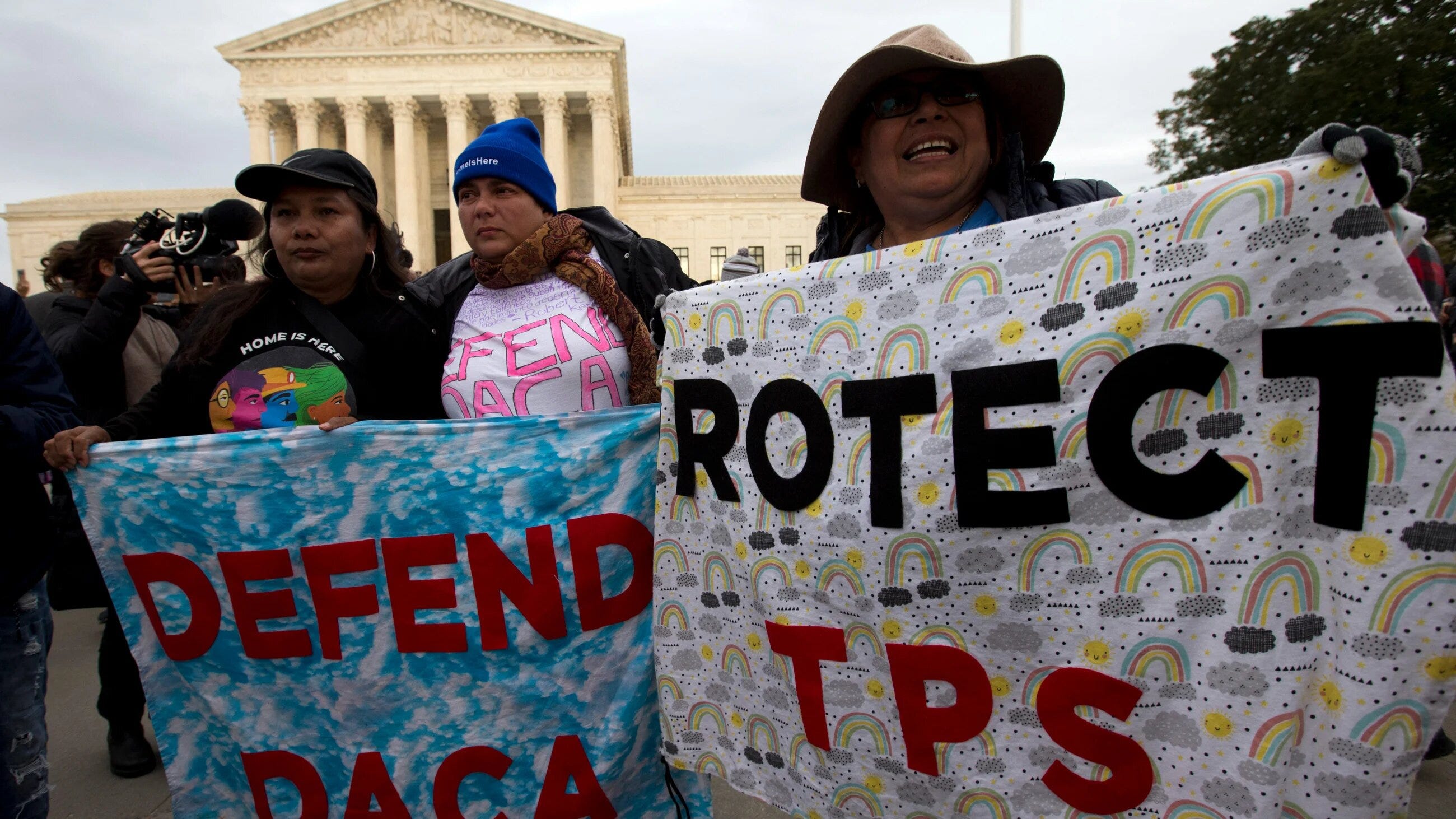
On April 29th, the U.S. Supreme Court will hear arguments challenging the Trump administration’s unlawful attempts to end Temporary Protected Status (TPS) for Syria and Haiti. What’s at stake is not just a legal question before the Court, but the fate of hundreds of thousands of lives, including my own.
My name is “Dahlia Doe” – or at least, that is the name that appears on the legal filings. I’m a TPS holder and a proud resident of New York City, where I work as a research director. I am also the lead plaintiff in the class action lawsuit on behalf of Syrian TPS holders that the Supreme Court will hear alongside a separate lawsuit on behalf of Haitian TPS holders.
My parents left Syria in the 1980s. While I have Syrian citizenship, I have no ties to the country and don’t know what I would do if I were forced to move there. I came to the United States on a student visa when I was 18 years old, drawn by the opportunity to study and build a future.
With TPS, I was able to remain and work in the country legally. When I graduated from college, I found a job I really loved. This country has shaped my life profoundly—from my career, my closest friendships, to my role in my community. This is also where my family is. My sister is an American citizen and later sponsored our parents to come to the United States. I also care for my elderly parents and help support them financially.
My ability to do that was made possible by TPS, a humanitarian program created by Congress in 1990 that protects people from countries in crisis from being sent back to danger and gives us the ability to live and work legally. The Secretary of Homeland Security can designate certain countries for TPS when it’s not safe for people to return, such as during war, natural disasters, or other extraordinary conditions.
TPS for Syria was designated in 2012 as a result of brutal government repression of civilians and the rise of violence between armed anti-government groups and the Syrian military; it has been extended repeatedly as the conflict developed into civil war and continued devastation and insecurity. At least until President Trump took office.
On September 19, 2025, the Trump administration announced that it would terminate TPS for Syria in just 60 days, and I felt everything I had built begin to slip away. I knew TPS was in the administration’s crosshairs, but the reality of potentially having to pack up my life, give up my career, and leave my family–all in a matter of two months–made me feel sick to my stomach. I work hard, I contribute to my community, and then overnight I felt as though none of it matters. That I don’t matter. It was devastating.
The Trump administration has also indefinitely paused decisions on all immigration applications, such as green cards, for Syrians, meaning I don’t have any alternatives besides TPS. Losing it wouldn’t just affect me, but my family too. My father has a green card, and I am his primary caregiver as he battles Parkinson’s disease. The thought of being separated from him and forced to return to Syria is terrifying.
The law is clear: as long as a country remains unsafe, TPS protections should continue. However, President Trump campaigned on ending TPS and his administration has so far tried to end protections for 13 different countries. Government officials were aware of the ongoing dangers TPS holders would face in Syria but terminated the designation anyway. A policy analyst who formerly worked at DHS during the Trump administration was quoted in the New York Times saying, “Unfortunately, I was part of the team that dismantled TPS. Countries I’d written up as unsafe a few months earlier were supposed to be safe now. It was a complete farce. Even if it was still unsafe to return, they said it was not in the national interest to continue the programs.”
I’ve never been the type to give up easily, but it wasn’t easy to speak up. I stood to lose my life here, my ability to care for my father, and my future. Even so, staying silent was not an option. So when the International Refugee Assistance Project (IRAP), Muslim Advocates, and Van Der Hout LLP decided to challenge the termination, I stepped forward to be a plaintiff, not just to tell my story, but to tell the story of thousands of Syrians like me.
We filed a case on behalf of all Syrians with TPS and those with pending applications, and just three days before the termination was set to go into effect, a federal court ordered it be delayed while our case moved forward. That ruling felt like a lifeline being thrown into the water when we were drowning.
Now, we’re under threat again. The government has asked the Supreme Court to let it end TPS for Syria and Haiti immediately. If the Court sides with the government, more than 350,000 Haitians and more than 6,000 Syrians, including me, would be stripped of our legal status. Not only would we lose our ability to live and work legally in this country, but we could be detained and deported to countries that by any objective measure, are still in crisis.
Syrians and Haitians aren’t the only ones at risk. The Trump administration is asking the Supreme Court for the power to disobey Congress and arbitrarily end TPS for all countries—and to have those actions be unreviewable by courts. More than 1.3 million people from 17 TPS-designated countries could be impacted if the Supreme Court greenlights the Trump administration’s discriminatory agenda. It would be the largest “de-documentation” of people with legal status in U.S. history.
My story is just one of many. Like me, most TPS holders have lived in the United States for years, in many cases more than a decade. We are neighbors, colleagues, and family members who are deeply integrated into communities around this country, as a collection of stories shared as an amicus brief to the Supreme Court makes clear. April 29th will be a consequential day, not just for me, but for the rule of law in this country. The future of countless individuals, our families, and every single person who cares about us is at stake.
TPS doesn’t exist in a vacuum. If the administration is allowed to move forward, more than a million people could become undocumented with the stroke of a pen. This won’t just affect our lives, but will have ripple effects across every part of the United States. When deciding this case, I ask this Court to follow the laws written by Congress, not the open bigotry driving this administration’s actions. TPS is not a political abstraction. Hundreds of thousands of people who have worked hard, raised families, and contributed to this country in every way asked of them are depending on this decision. Please protect us.
Dahlia Doe is a Syrian TPS holder and the lead plaintiff in Dahlia Doe v. Mullin, one of two TPS cases that will be heard by the Supreme Court on April 29. She filed the lawsuit using a pseudonym for her safety.

Stay strong Dahlia. You and all immigrants, documented or not are the backbone and future for the United States. Go shame the bigots on the Supreme Court.