
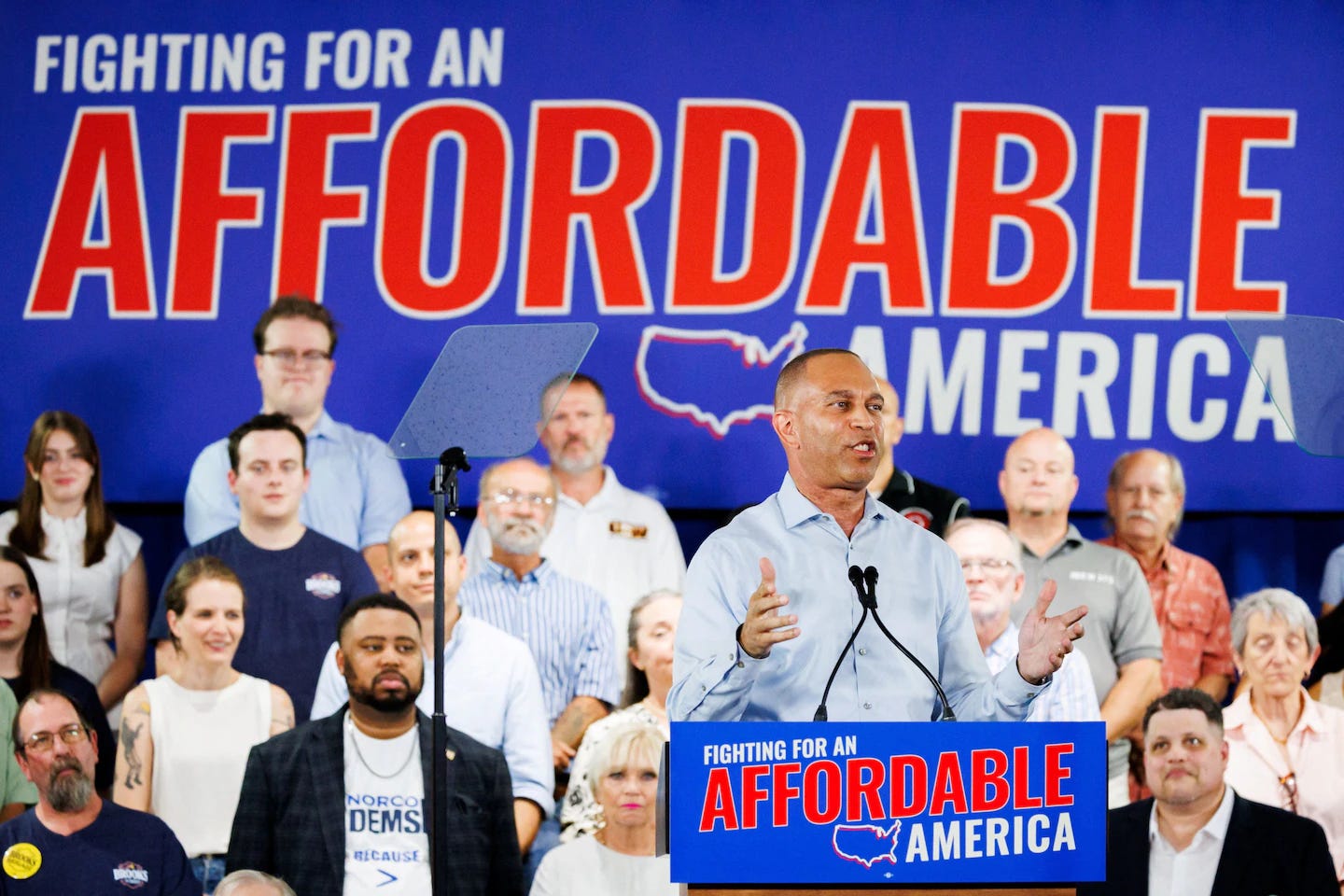
On August 31, House Minority Leader Hakeem Jeffries outlined Democrats’ priorities should they win back the House majority. His agenda tracked closely with the issues dominating voters’ concerns in midterm polling, including the war in Iran, healthcare costs, Trump’s tariffs, and, above all, the cost of living. But immigration was conspicuously absent from Jeffries’ governing priorities that day.
Watching the press conference, I was reminded of how often Democratic leaders respond to the difficult politics of immigration by avoiding the issue altogether. The omission was particularly striking after a brutal summer of immigration news. On July 27, hundreds of thousands of Haitians lost Temporary Protected Status, stripping them of their right to work legally and remain in the country. Immigration arrests hit record highs each month, climbing from 43,000 in June to nearly 50,000 in July.
On August 25, Alex Pretti’s family gave their first television interview. Seven months after he was killed by federal immigration agents in Minneapolis, they said they still didn’t have answers about what happened to him and no one had been held accountable.
On the day of Jeffries’ press conference, Pierre Damas Bel, a 20-year-old Haitian college student who lost his TPS, died in an apparent suicide. In the week that followed, his family said Pierre had grown increasingly withdrawn after ICE fitted him with a GPS ankle monitor.
The injustices caused by Trump’s mass deportation policies may be fading from the political conversation, but the families, businesses, and communities affected are still living with the devastating consequences.
As Jeffries listed the fights Democrats will take on if they regain power, he also left out a major effort already underway—a discharge petition to force a vote on the American Dream and Promise Act. The bill would create a path to citizenship for eligible TPS holders as well as Dreamers. Jeffries himself supports the legislation, and the petition gives Democrats a way to pressure Republicans on Trump’s unpopular deportations now, and in the future.
Since I started working on political campaigns, immigration has never been the top voting issue for Democratic voters, but Democrats still need a plan for how they will govern on it. Biden struggled for years to control the border, and his promise to create a path to citizenship for millions of undocumented immigrants went unfulfilled. Those failures made immigration a major political vulnerability for Democrats and left millions of people exposed to Trump’s policies in the process.
Avoiding immigration may feel politically easier in the short term, but if Democrats return to power, it’s their responsibility to try to rein in Trump’s immigration policies and offer an alternative to both Biden and Trump. If they are still struggling to talk about immigration after all that has happened during Trump’s mass deportation campaign, why should voters trust them to govern differently?
The party’s failure to articulate a vision for immigration reform is also making it harder for candidates on the trail to figure out what they want to say about it. I’ve heard the same concern over and over from candidates I’ve worked with this cycle. Many are hesitant to talk about immigration because they worry it leaves them open to Republican attacks. They aren’t wrong. According to Pew Research, Republicans still hold a five-point advantage over Democrats on immigration. But avoidance creates its own political vulnerability. Republicans are portraying Democrats as offering more of the same policies voters rejected under Biden.
Democratic candidates don’t need to make immigration a centerpiece of their campaigns, but they should make the case that their policies would benefit the country more than mass deportations. Meanwhile, Republicans still see immigration as a winning issue. Republican campaigns have spent more than three times as much as Democrats on immigration ads, $53 million to $17 million. Their ads have run across 88 races in 27 states, compared with just 20 races in 11 states for Democrats. The gap is especially striking as public support for Trump’s handling of immigration has fallen.
Democrats are also missing an opportunity to connect immigration to the affordability argument they are already making against Trump. Brookings has found that employment has fallen in communities experiencing increased immigration enforcement, including among American-born workers, while reduced immigration is also slowing economic growth. Yet few candidates have connected Trump’s immigration policies to the cost-of-living debate, which could help voters better understand the downsides of Republican immigration policies.
Part of the challenge is that some elected officials outsource the work of developing a governing agenda to nonprofits and think tanks. When I worked at an immigration nonprofit, I had the freedom to do blue-sky thinking and develop a new vision for border security. But as a former White House and congressional staffer, I also understood that immigrants’ rights groups have a different audience and objective. They can push Democrats to think bigger without having to weigh the demands of an election, and it’s their job to keep pushing for change once Democrats are in office. Elected officials, by contrast, have to weigh immigration against competing priorities while keeping their constituents engaged in the process.
Elected officials can and should turn to think tanks and nonprofits for ideas and technical expertise, but they have to do the harder work of understanding what their own constituents will actually support. And they can’t just rely on one-off polls to answer that question. That matters even more now, when immigration may not be dominating the news even as the consequences of Trump’s policies unfold.
Polls capture one moment in time and simplify complicated immigration policy to make it accessible to respondents. Many are commissioned by interest groups and polling firms that have their own policy agenda to advance. While they can provide valuable information, they should not be the only way elected officials gauge what Americans might support. Just because immigration is not at the top of voters’ minds right now doesn’t mean they don’t have opinions about it.
Democratic leaders who have successfully connected with voters in Trump’s second term are experimenting with more direct forms of public engagement. They don’t just talk to voters about what’s on the news that day. New York Mayor Zohran Mamdani and Florida Senate candidate Angie Nixon have relied on neighborhood canvassing and direct voter contact to develop their policy agendas. They are also finding channels outside of traditional media, formal press conferences, and campaign ads to reach people and explain why their priorities are what they are.
Democrats in the House and Senate should do the same on immigration. There are several different groups of lawmakers working together right now to try to develop new solutions, but they are doing so largely behind the scenes. They engage quietly with different interest groups in D.C., or with state organizations with a special interest in immigration, but these lawmakers should take their brainstorming out of Washington.
They could start in my home state of New Mexico, where immigration and border security have long concerned voters. Like many states in the country, New Mexico’s population is aging and shrinking. Lawmakers could ask voters directly how immigration could help keep schools and hospitals open and revitalize their communities. Figuring out what New Mexicans want from a modern immigration system could give the party a useful baseline. That’s important because the state will hold the fourth Democratic primary contest in the 2028 presidential election, giving voters an opportunity to winnow the field of candidates.
Jeffries will understandably spend much of the midterms and the new Congress focused on the issues voters rank highest, but the party needs more elected officials willing to explain how immigration reform connects to affordability, economic growth, and the health of American communities. Governors, mayors, and other state and local leaders should be part of the conversation too. Trump and his surrogates talk about their immigration policies every chance they get. We have some catching up to do.
Washington too often relies on the same tired immigration proposals that have already been introduced and failed in Congress, sometimes more than once. And it’s not just elected officials. Even immigration policy experts seem stuck debating the same solutions they’ve been offering since I started this work in 2010, if not longer. Trump has upended the entire system, creating an opening for Democrats to approach reform in entirely new ways.
Jeffries should make clear that immigration reform belongs on the Democratic agenda now. What kind of immigration system would Democrats actually fight to build if they return to power? By treating immigration primarily as a political liability—and avoiding the issue—Democrats are losing time to answer that question.
Amen! Are you listening, Leader Jeffries et al.? It's high time that immigration be an election issue for ALL parties, not just MAGA Republicans.
Republicans can teach their minions to parrot “CommonSense” as their message for governing.
Democrats understand Republicans lack the ability to gather and analysis the facts, use critical thinking and present a rational and humane policy. Unfortunately, many Democrats lack courage to stand by what is right. Ernie