
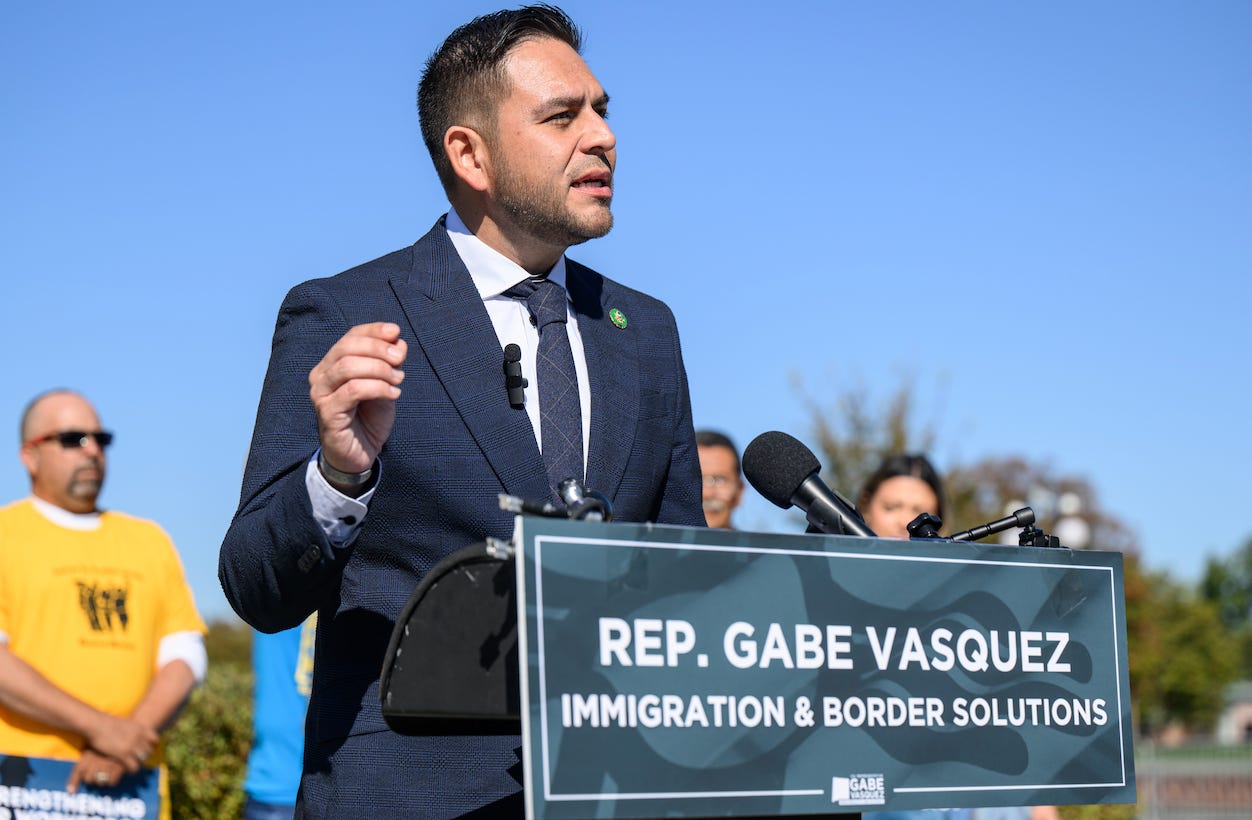
As someone raised on both sides of the border, I’ve crossed the border more times than I can count. Over the course of my life, I’ve crossed at most ports of entry in New Mexico, Texas, and Arizona. As both a local elected official and a member of Congress, I’ve walked the line many times with ranchers and border patrol agents over the years. In the most rural stretches of New Mexico’s bootheel, I have ridden on horse or mule, pursuing the elusive Coues deer during hunting season almost every year, covering borderlands most people never get to see (and knocking down the occasional Montezuma quail when I can).
I know the border well — what makes our trade economy tick, the binational family ties that bond border cities together, the rugged terrain in its most inhospitable stretches, the staffing shortages that create long lines at its ports of entry, and the immense challenges my district faced during recent mass migration events.
I have the privilege and responsibility of representing nearly 180 miles of the U.S.-Mexico border in Congress, serving New Mexico’s second district today. The voters — many of whom share my experience of life along the border — trust me and want real change in their communities, including our border colonias, unincorporated rural communities. Before running for Congress, I served as a City Councilor in Las Cruces, New Mexico — Andrea’s hometown, and my home for the last 23 years. And it was there that I faced the first border crisis as an elected official.
In 2019, while I was serving on Las Cruces City Council, mass migration events stemming mainly from Guatemala, El Salvador, and Honduras presented a major challenge. Thousands presented themselves at our border, seeking refuge and asylum from the type of dreadful violence and economic insecurity that made their long and dangerous journeys seem like a better alternative than staying home.
Within weeks, thousands of distraught, tired, and desperate families were on our streets and dropped off by the federal government daily in the middle of our city. Human beings that needed to eat, bathe, and feel safe — including children who deserved to see the sun rise, smile, and play without fear — were ending their perilous and torturous journeys in Las Cruces. So we took care of them, and I proudly led that fight along with our community organizers, stringing together city resources so at the bare minimum, children had something to eat.
But there had to be a better way. Our border was overwhelmed, and the system was broken. Both parties have failed to fix our immigration system for far too long, and this was one of its many ugly symptoms.
Republicans and Democrats have spent years politicizing immigration, swinging between inaction, cruelty, and chaos; labeling it as an “impossible” problem and dodging their responsibility to fix it; and simultaneously sabotaging real opportunities for any meaningful reform so they can recycle their talking points in the next election. And despite this being one of our nation’s top political issues, most federal lawmakers who have big opinions on immigration and border security have never even been to the border, don’t know what it’s like to be a new immigrant in this country, and are unaware of the many hurdles folks have to jump to get through the legal immigration system.
But that’s why I’m here, and why I believe policymakers from border communities can bring about real, tangible change. People like Andrea and I know both the realities of the frontera and the ugly political realities of Washington, D.C. And we know that moving the ball forward on immigration is the most important thing we can do right now — because risking inaction for another decade is not progress — and the truth is, the system will never be perfect. But it can be better, more humane, more predictable, and safer for all Americans.
It is because of the inaction and incompetence we have historically seen on this issue that we now see the cruelest policies and ideas taking root in our country. The administration and ICE’s mass deportation policies have ushered in a new era of cruelty, family separation, racial profiling, and even the use of the military for civilian engagement on American streets. Unpredictable tariffs, deteriorating international relationships with our largest trade partners, and higher prices for all Americans are the new norm. It’s awful, and Americans are yearning for an alternative.
That’s why I’ve been working with Andrea and other issue experts, along with my colleagues in Congress, to create the New American Immigration Plan. It’s a practical, commonsense way forward that will take us in the right direction. It’s not a single bill, it’s a set of principles for us to agree to and take action. One that removes extreme politics from both parties and upholds our American values at every turn by implementing smarter secure borders, prioritizing the restoration of U.S. economic dominance and affordability, and establishing fair and strategic pathways to legal status — creating an immigration system that works and is fair and balanced.
Here’s what’s in the plan:
First, we have to truly understand what it means to secure our border and invest in the smartest solutions possible. Every part of the border is different, and lawmakers have failed to realize that.
For too long, we’ve measured “security” by how loud the rhetoric is or how tall the wall is, not by whether it actually works in urban environments and rural mountain ranges. The truth is, border agents and residents on the ground will tell you the same thing every time: technology matters — it’s a wiser, more efficient, and more environmentally friendly way to reach operational control. We can do that. Democrats can lead, and it can pave the way to longer lasting reforms.
That’s what I recently told Secretary Hegseth — who clearly doesn’t care about the details, or willfully ignores them — a physical wall isn’t right or the most cost-effective way to monitor our border’s most rugged terrain. He admitted it, then walked it back.
Autonomous Surveillance Towers, or ASTs, are our best option for rugged border areas. Aerostats help a lot. Modern x-ray scanning, intelligence-driven enforcement, adequate and well trained staff, and counter-drone capabilities matter — that’s how you stop cartels and drug smugglers from bringing in the bulk of illicit goods. That’s also how you stop the coyotes and the polleros from human smuggling. That’s how you disrupt trafficking networks that prey on vulnerable women and children. And that’s how you make the border safer without wasting billions painting a border wall black, easily beaten with a $4 pair of work gloves.
Investing in the right tools also saves money in the long run — money we should be using to properly staff, train, and pay the customs agents at the border doing this work. These are the blue shirts, personnel from the Office of Field Operations, the folks who handle legal traffic and commercial imports and exports. Border security works best when it’s targeted, professional, and focused on real threats, not when it’s used to meet the President’s arbitrary deportation quota to score points on cable news and drives border patrol and the military into our inland cities.
Second, immigration policy should reflect the economic needs of our nation, so that our fields can flourish, our construction industry can thrive, we can rebuild our infrastructure and meet the most in-demand workforce needs that fuel our nation’s economy.
Anyone who’s tried to hire a caregiver, build a home, harvest crops, hire a construction crew, or staff a hospital knows a basic truth: immigrants get the job done, and they’d be out of business without them. At the same time, we can’t adversely impact the opportunity for Americans to have those jobs, and whenever and wherever possible, our policies should make investments and incentivize employers to give every American an opportunity to fill these positions. Another reality is that we’re competing with China, Russia, and other countries for leadership in the technologies that will define the next century — from AI to quantum computing — and if we fall behind, we will lose our standing in the global economy.
A serious immigration plan has to recognize that legal, well-regulated pathways for in-demand workers strengthens our American workforce instead of undermining it. When we match visas to real economic needs — in agriculture, construction, health care, child care, and emerging tech — we lower costs, grow the economy, and keep innovation here at home. Immigrant workers have always been core to the American economy from our nation’s very birth, and we can unlock a new era of U.S. economic dominance with these smart immigration policies.
That’s not ideology. That’s building a stronger nation.
Third, enforcement has to reflect our American values.
We are a nation of laws, a nation that believes in due process, fairness, and basic human rights. Those ideas are bipartisan, and they’re what make us American.
When the government strips legal status from immigrants with visas or green cards who are following the rules or targets moms and workers for deportation, it erodes trust in the system and discourages people from following the rules and adhering to legal pathways.
We can enforce immigration law and prioritize removing violent criminals without relying on fear, profiling, or unchecked detention. We can, and must, demand transparency, humane conditions, and accountability from enforcement agencies. We can stop people from disappearing into a system with no oversight and still maintain order at the border. In fact, that’s how you restore trust — in law enforcement and in government itself.
When enforcement is humane and accountable, it’s stronger, not weaker.
Finally, we have to fix what’s been broken for decades: legal pathways for folks to work and live in this country, without fear of deportation.
Right now, our system traps people who have worked, paid taxes, raised families, and followed the rules in a permanent state of uncertainty. These folks are forced to live in permanent fear. It’s not just unfair and inhumane, it’s also bad for workers, employers, and communities.
A commonsense system creates clear, legal ways for people who contribute to our country — and who pass background checks — to earn status and stability. That brings people fully into American society, strengthens the rule of law, and allows families and industries alike to plan for the future.
I won’t pretend immigration is simple. But I’ve seen what happens when Washington gets it wrong, and the stakes are too high to not act.
I’ll end with this: the border is not just a political talking point. It’s a place. It’s people. It’s work, family, culture, and history layered like an onion from the Hatch Valley right here in southern New Mexico. It’s complex and it’s beautiful. And we can move the ball forward if we choose to talk with each other and compromise. If we want immigration policy that finally works, we need to start listening to the leaders and policymakers who have an intimate, real-life view of the border and immigration policy and have the courage to change course.
I believe the New American Immigration Plan is a step in that direction. I will be asking my colleagues in Congress to help support commonsense reform that most Americans can agree with, built right into this plan. And I believe the country is ready for it.

I see nothing in regard to accountability. Just more money for CBP/ICE and the same programs like DACA and TSP that are now decimated. More of the same from dems.
How do you prevent the pathways from being axed and enforcement expanded during debate? That was the legacy of the last comprehensive information reform attempts.